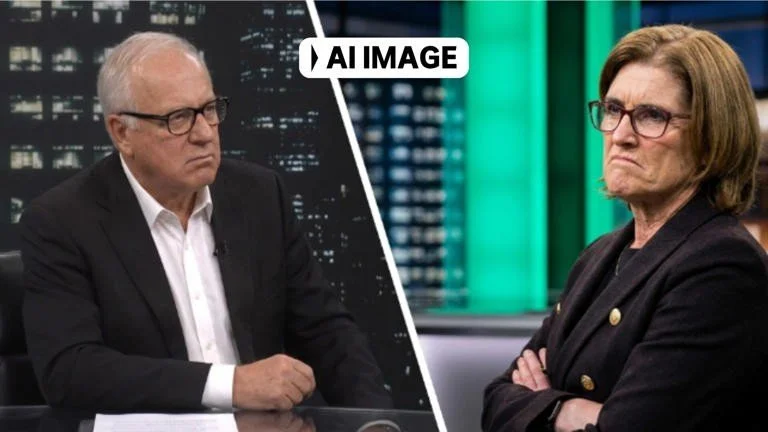
Image source: Alan Kohler and RBA governor Michele Bullock have been caught up in an AI deepfake scam promoting cryptocurrency. (Supplied: ASIC)
When we think about national security, most of us still picture military capability, critical infrastructure protection, intelligence operations and cyber defence.
Yet one of the most significant threats facing Australia today does not arrive by air, sea or even through a network intrusion.
It arrives through information.
The rise of misinformation, disinformation, synthetic media and AI-generated content is fundamentally changing the security landscape. False or manipulated information can spread globally in minutes, influence public behaviour at scale, undermine confidence in institutions and disrupt decision-making during critical events.
We’ve already witnessed the consequences.
During the COVID-19 pandemic, misinformation about the virus, vaccines and public health measures spread faster than official advice in many communities around the world. The result was more than confusion. It affected public trust, policy implementation and community cohesion.
During natural disasters, misinformation has repeatedly complicated emergency response efforts. False evacuation notices, fabricated emergency warnings, manipulated images and misleading social media posts have diverted attention from official sources and increased uncertainty for affected communities.
More recently, advances in generative AI have made it possible to create highly convincing fake images, audio recordings and videos. Capabilities once limited to sophisticated state actors are now increasingly accessible to anyone with an internet connection.
In many cases, the objective is not necessarily to convince people that something false is true.
It is to create doubt, confusion and mistrust.
This is where information resilience, and the human dimension of information warfare, becomes critical.
Cybersecurity protects networks, systems and data. Information resilience helps protect the ability of people and organisations to make informed decisions based on trusted information. As technology makes manipulation easier and cheaper, the ability to identify, resist and respond to misinformation and disinformation is becoming a critical national capability.
Australia’s resilience therefore depends on more than government action alone.
Industry operates much of the nation’s critical infrastructure, communications networks, technology platforms, supply chains and essential services. A misinformation campaign targeting a water utility, electricity provider, telecommunications operator or emergency management agency during a crisis could have consequences far beyond reputational damage. It could influence public behaviour, undermine confidence in authorities, complicate response efforts and amplify the impacts of an incident.
Trust has become a critical national asset.
The question is no longer whether organisations will encounter misinformation.
The question is whether they are prepared for it.
This is why Australia must build resilience in the information environment across Defence, government, industry and the broader national-security community.
Organisations need to move beyond viewing security solely through a technical lens. Resilience today requires investment in information integrity, trusted communications, critical thinking, workforce awareness and decision-making under conditions of uncertainty.
This is one reason the Australian Information Warfare Alliance (AIWA) matters.
AIWA brings together sovereign Australian companies with complementary expertise across information warfare, information operations, cyber, C4ISREW, intelligence, strategic communications, training, research, science and technology to support Defence and the national interest.
As part of AIWA, DEWC collaborates with and encourages Defence, government, industry and academia to work together to better understand and manage misinformation and disinformation as part of Australia’s broader national security resilience in the information environment. For DEWC, this connects naturally to our work in C4ISREW, information advantage, decision support, operational analysis, experimentation and trusted Defence delivery.
National security in the 21st century is not simply about protecting infrastructure, networks or borders.
It is also about protecting trust.
In an age where misinformation can spread faster than facts, Australia’s ability to build resilience in the information environment may prove to be one of the most important investments we make in our future security.